

 |
| 
home | why stories? | how we work | for schools | sponsorship | our organization | texts & links | about us | contact 
STORIES FOR SOCIETY- BERÄTTELSER FÖR SAMHÄLLET
Why is Stories for Society relevant for your school?
Using our method we can help you in the following areas:
Social Development
- Pursue your goals concerning the development of children's curiosity and knowledge in critical areas such as diversity, equality, human rights and environmental sustainability;
- Work with a norm-critical approach to make existing norms, power structures and hierarchies more visible, and to put equality and participation in focus;
- Develop your school's competitive edge in providing an education in social skills such as effective communication, group dynamics and self-confidence.
Health, Food and Active Life
- Develop children's understanding of the importance of good health;
- Stimulate interest in good food, daily physical activity and other healthy habits;
- Promote the idea of taking responsibility for one's own health;
- Work together with school nurses, gym/PE teachers and other adults at schools to develop the school's program concerning health, food and active life.
Environmental Knowledge and Skills
- Develop your school's activities concerning nature and the environment which includes children as active participants;
- Ease children's understanding of large and often abstract environmental challenges such as climate change, water supply and natural disaster;
- Inspire children to be in the outdoors by awakening their curiosity in nature at the same time as they become conscious of the need to take responsibility for the environment in their local area.
Core Subjects
- Open up children's interest in learning in basic school subjects such as, for example, English, other languages, nature and the environment;
- Contribute to increased competence in basic skills such as writing, reading, drawing, presentation, group work, listening, etc.;
- Take an inclusive approach to learning, including allowing the participation of children with special needs.
Culture
- Deepen engagement in working with aesthetic learning processes;
- Create material for reflection and continued work in the form of, among other tools, workbooks with children's illustrated stories.
Learn more about how we work.
What do we offer?
Try out a story-telling process
Engage our facilitators to run a story-telling process in the class room where the teacher is an observer and participant. See information about our basic process in the class room.
Basic courses for teachers/facilitators
- 2-day theoretical training in our method
- 8 x 1.5 hours practical training in the classroom with the support of a facilitator
- certification
- follow-up and coaching
Thematic courses
- 1-2 theory days in special areas where certified teachers would like to use the story-telling process. These could be social skills areas or basic school subjects.
- Courses which assist teachers to use story-telling as an integral part of teaching and learning.
- Tailor-made courses for schools which would like to deepen its engagement in a particular subject matter using story-telling.
Contact us for further details about our services and prices.

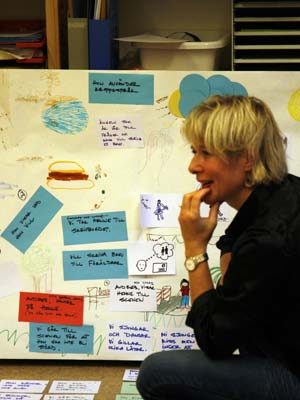
Image from a project at Munsö skola, Ekerö, Sweden, 2010.
"You really have an in-depth approach that is like few other projects that I have seen."
- Rector
"I think you do a great job of capturing the children's thoughts and ideas."
- Teacher
Learn more about how we work at schools. Contact our Partner School!
Read more about what happens when kids tell stories.
Contact us for prices, further information and references.
sponsorship | for schools | stories children tell | donate now!